





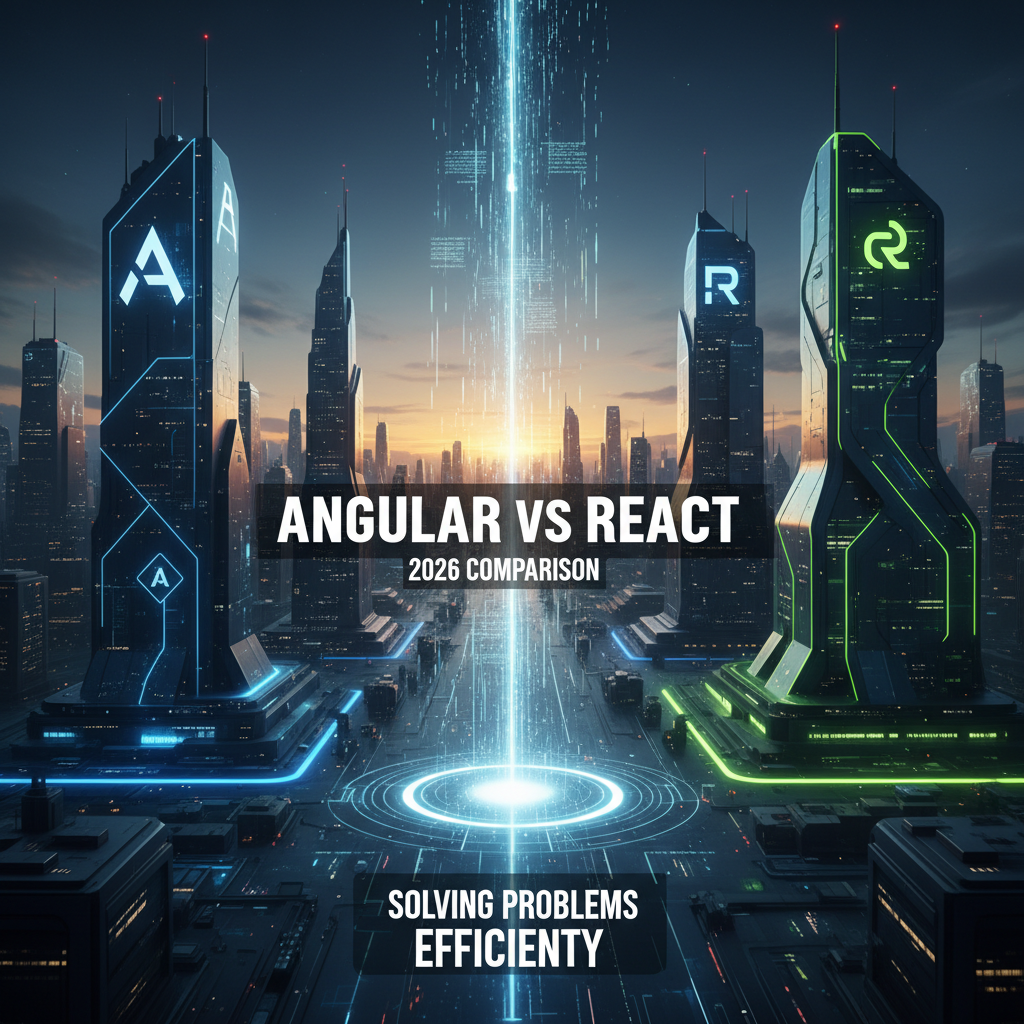
Angular VS React – 2026 Comparison – Which Platform Solves the Problem Efficiently
This post has been read 10 times.
Introduction
As we venture into 2026, the landscape of web development continues to evolve, driven by ever-changing technologies and user demands. Among the most popular JavaScript frameworks, Angular and React have garnered significant attention from developers and businesses alike. While both platforms have their unique strengths and weaknesses, this blog post aims to provide an in-depth comparison of Angular and React, helping you determine which one is the most efficient for your development needs.
Overview of Angular and React
What is Angular?
Angular is a platform and framework for building single-page client applications using HTML and TypeScript. Created and maintained by Google, Angular provides a comprehensive solution with an integrated development environment (IDE) and a set of tools designed for building robust web applications. Its architecture follows the component-based approach, allowing developers to create reusable UI components.
What is React?
React, developed and maintained by Facebook, is a JavaScript library focused on building user interfaces. It simplifies the creation of interactive user interfaces through the use of components, enabling developers to manage the view layer of their applications effectively. React is often lauded for its flexibility and the ease with which it integrates with other libraries and frameworks.
Performance Comparison
Rendering Capabilities
When discussing performance, one critical aspect to consider is how each framework handles rendering.
– Angular employs a two-way data binding approach, meaning that changes in the UI automatically update the model and vice-versa. While this can simplify development, it might lead to performance bottlenecks, especially in large applications with numerous bound elements.
– React, on the other hand, uses a virtual DOM to optimize updates. When a change occurs, React creates a virtual representation of the UI, calculates the difference, and then applies the most efficient updates to the actual DOM. This process generally leads to superior performance and a smoother user experience, especially in large-scale applications.
Load Time and Speed
Both frameworks have mechanisms to enhance speed and reduce load time:
– Angular utilizes Ahead-of-Time (AOT) compilation, which compiles HTML and TypeScript into JavaScript code during the build process. This can result in faster application startup times.
– React, in contrast, captures changes in state and props without necessitating a full re-render of the component tree, providing an incremental optimization that enhances speed during user interaction.
Learning Curve and Developer Experience
Angular’s Learning Curve
Angular is often regarded as more challenging to learn, especially for newcomers to frontend development. The reliance on TypeScript, a superset of JavaScript, introduces additional complexity. Moreover, developers must become familiar with its comprehensive tooling, including Angular CLI, RxJS for reactive programming, and detailed build and deployment processes.
React’s Learning Curve
React has a more straightforward learning curve, particularly for those already familiar with JavaScript. Its component-based architecture allows for isolation in managing UI state, making it easier for new developers to grasp the essentials. The extensive ecosystem of libraries, from routing to state management (like Redux or Context API), provides flexibility and choices, which can be overwhelming but also empowering.
Community Support and Ecosystem
Angular Community
Angular benefits from robust support due to its association with Google. The documentation is comprehensive and well-maintained, which aids developers in navigating complex concepts. Additionally, active community forums and user groups provide assistance, though the community is slightly smaller compared to React’s.
React Community
React boasts one of the largest and most active developer communities in the world. The abundance of resources, plugins, and third-party libraries has made it a go-to choice for many projects. This wide-reaching support means that developers can find solutions more easily and innovate rapidly.
Use Cases and Suitability
Angular Use Cases
Angular is particularly well-suited for enterprise-level applications, complex systems that require a cohesive structure and robustness. Its built-in features, such as dependency injection, advanced routing, and forms handling, make it easier to manage larger projects that require consistency and maintainability over time.
React Use Cases
React shines in applications that prioritize user interaction, such as social media platforms, dashboards, and any project requiring a high degree of dynamic content. Because of its flexibility, it is often chosen for projects where rapid development and scalability are key.
Conclusion
As we analyze Angular and React in 2026, the choice between the two comes down to specific project requirements, team expertise, and long-term maintenance considerations. Angular may be the better choice for structured, large-scale enterprise applications, while React is ideal for fast-paced projects that need rapid development and responsiveness.
Ultimately, whether you choose Angular or React, understanding your project’s needs will drive your decision. As both frameworks continue to evolve, they will undoubtedly adapt to address the demands of the modern web application landscape.
Final Thoughts
In conclusion, Angular and React each have their unique advantages and challenges. Making an informed decision based on this comparison will help set the foundation for a successful development project. The best approach is often to prototype and experiment, allowing you to find which framework aligns best with your objectives.